

Graphic Design and Artificial Intelligence: The Project Comes First
Generative AI tools can create images, develop variations, edit photographs, or speed up certain stages of the workflow. But on their own, they cannot guarantee that a result is suitable for its audience, consistent with an identity, readable, relevant, or accurate.
These are design decisions. And it is precisely the ability to make them that distinguishes the work of a graphic designer from simply using software.
For this reason, studying graphic design in the age of artificial intelligence does not mean learning how to compete with a machine. It means developing the method, visual culture, and critical thinking needed to direct these tools rather than simply accept their outputs.
Artificial intelligence is changing above all the speed of certain production stages. Moodboards, references, visual variations, format adaptations, background removal, retouching, and early creative concepts can now be developed much more quickly. The initial exploration of a project can also become broader and more extensive.
What does not disappear is the problem that needs to be solved.
A graphic designer must still interpret a brief, understand an audience, establish priorities, choose a visual language, and build an information hierarchy. They must also be able to recognise when a solution works and when, despite being aesthetically convincing, it communicates the wrong message.
| AI can support and accelerate | The designer must remain in control |
|---|---|
| Visual research and references | Brief interpretation |
| Generation of alternatives | Strategy and concept |
| Drafts and variations | Visual hierarchy |
| Image processing | Typography and readability |
| Format adaptation | Brand identity consistency |
| Style exploration | Relationship with audience and context |
| Output production | Verification, selection and responsibility |
Professional value is therefore increasingly shifting away from execution alone and towards the ability to design, select and direct.
The World Economic Forum’s Future of Jobs Report 2025 captures this transformation clearly: AI and big data are identified among the fastest-growing skills, while creative thinking, analytical thinking and technological literacy are also becoming increasingly important. Technology and design skills are therefore not alternatives: they are becoming complementary competencies.
Il prompt non sostituisce il brief
A prompt can generate an answer. A brief defines a problem.
The difference may seem subtle, but for anyone studying graphic design, it is crucial. To achieve meaningful results with AI, you need to understand the language of design: composition, contrast, rhythm, hierarchy, grid, typographic weight, colour, tone, and the relationship between text and image.
A variation can be technically impressive and still strike the wrong tone. An image can be visually striking but inconsistent with the brand. An infographic can look credible while misrepresenting data.
Design culture is precisely what allows us to recognise this difference.
This is a topic particularly close to the work of Stefano Cipolla, coordinator of the RUFA BA in Graphic Design. A graphic designer and journalist, Cipolla has worked at il Manifesto and la Repubblica, contributing to two redesigns of the newspaper, and has been art director of L’Espresso since 2018. At RUFA, he teaches subjects related to editorial design, infographics and visual communication.
«Let’s talk about newspapers, the field I work in. Artificial Intelligence can design an infographic – a visual representation of information – in just a few seconds. But where does the data used to create that graphic come from? Who selected, verified and organised it? This is precisely the role of the graphic designer: checking sources, understanding which data and figures matter and how to prioritise them, and deciding which visual style to use in order to provide readers with the clearest and most effective infographic possible. Visualising information is a responsibility before it is a technique.»
From Image to Identity: Designing Visual Systems
Generating an image is very different from designing an identity.
A brand identity needs to work across a website, a poster, an app, packaging, a social post, a publication, and a physical space. It must be able to change format without losing its recognisability.
This is why graphic design is not only about producing individual artefacts. Above all, it is about building coherent visual systems.
This approach can also be seen in the work of Emanuele Cappelli, lecturer on the Graphic Design programme and coordinator of the MA in Visual and Innovation Design.
Cappelli is the founder of Cappelli Identity Design and has been working for years on the concept of dynamic branding. In 2025, the studio received recognition at the Compasso d’Oro, the German Design Awards and the World Brand Design Awards. Its Dynamic Brand method focuses on an identity’s ability to adapt across different channels while maintaining a consistent relationship between all its elements.
“AI is a powerful tool that can speed up certain stages of the design process. However, when building an identity, AI cannot go much beyond this intermediate phase. Identity, by definition, means ‘uniqueness’, not a ‘copy’ of something else. At RUFA, students learn how to manage and guide these processes.”
AI Is Already Part of RUFA Students’ Projects
Talking about artificial intelligence in creative education means, above all, experimenting with it within a project.
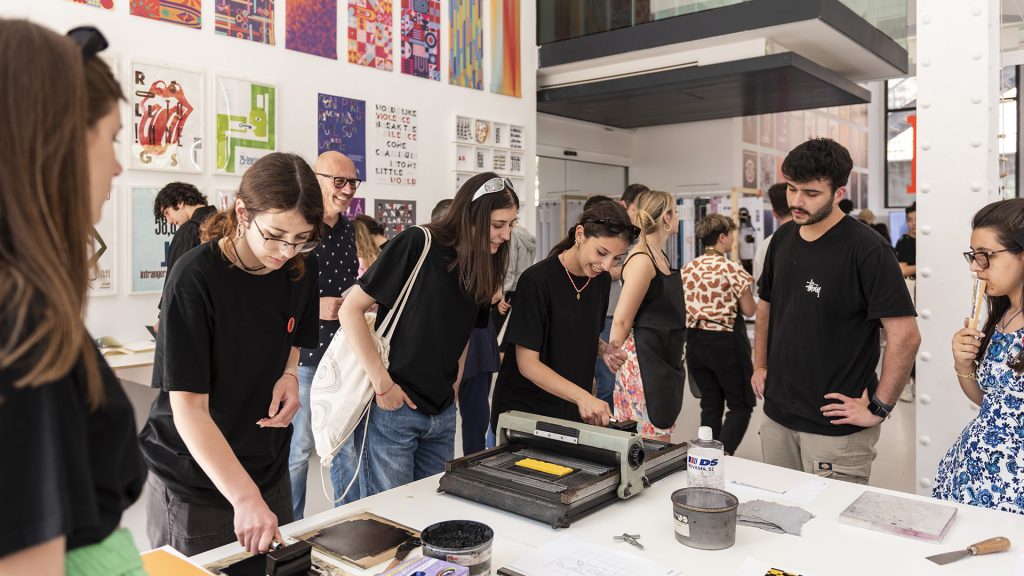
A concrete example is VISIONS OF TOMORROW, developed by international RUFA Graphic Design students during the first-year Computer Graphics course and exhibited at RUFA Culture Fest 2026, under the coordination of alumnus and lecturer Francesco Paolo Incantalupo.
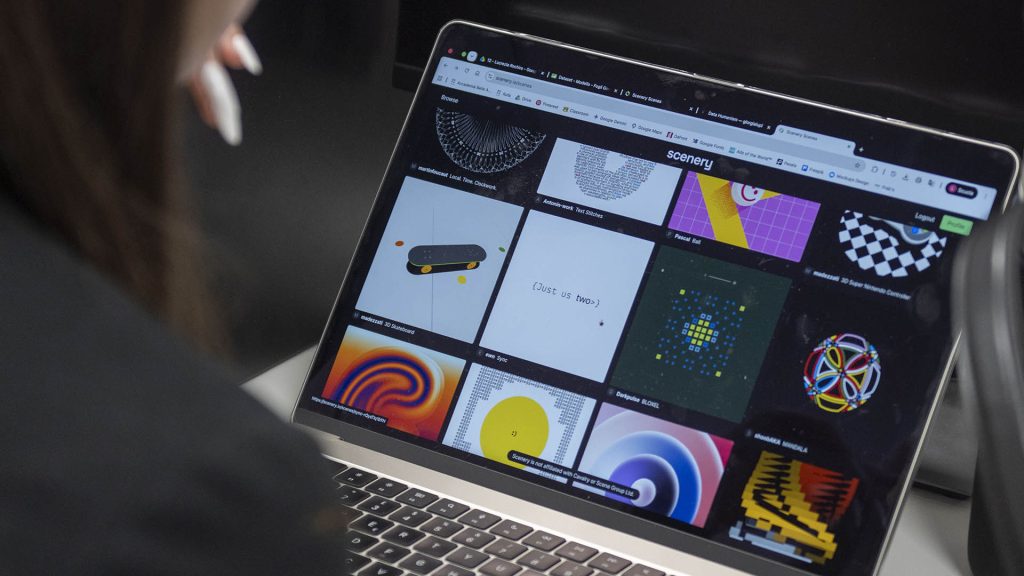
The project used AI tools integrated into Adobe Photoshop to build future scenarios and reflect on the relationship between technology, nature, and imagination. The works were then featured in imAIgine, an editorial project developed by Roberta De Cristofaro within the Computer Graphics course and now in its third edition, with issues dedicated to themes including the environment and “bodies of the future”.
But the use of artificial intelligence is not limited to projects specifically focused on AI. In the day-to-day work of the course, it enters at specific stages of the design process.
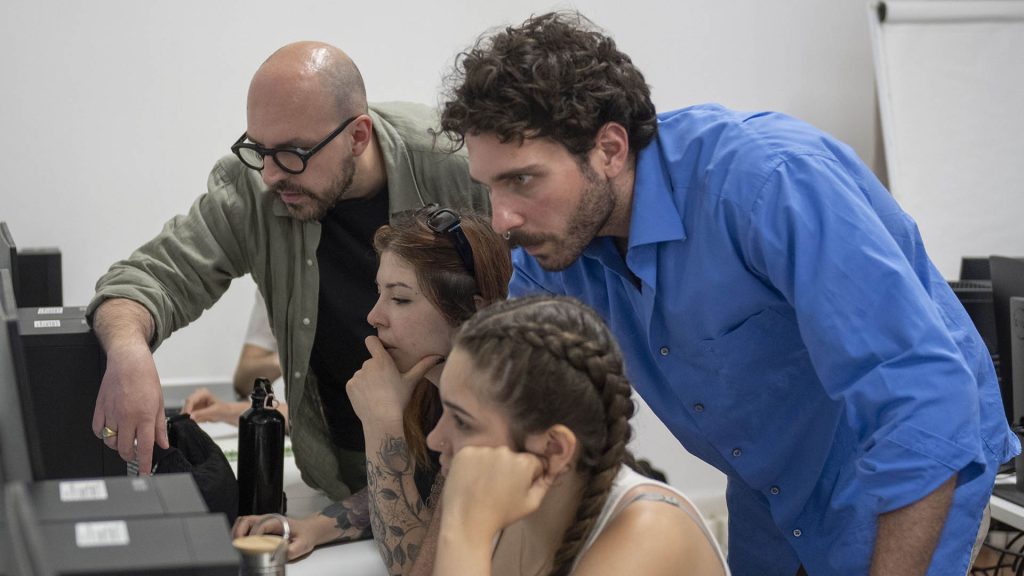
Francesco Paolo Incantalupo explains that it is used mainly in the preliminary phase, to speed up research processes, naming development, and the creation of initial drafts, and in the final phase, to create mockups that support the presentation of the project.
AI can therefore support the process before and after some of the key decisions, without replacing them.
«Whether it is a logo or a poster, the execution phase in which fundamental decisions are made – from typography and colours to images and forms, as well as the way these elements interact with one another and are organised hierarchically – remains rooted in a human and professional sensitivity that cannot be replaced.»
This approach changes the question.
No longer simply: “What image can I generate?”
But: “Why am I generating it, what idea should it express, and how does it fit into the overall project?”
This is where AI stops being an effect and becomes a design tool.
Typography, composition, and visual culture still matter, and the arrival of artificial intelligence does not make the foundations of graphic design obsolete. On the contrary, it makes knowing how to apply them even more important.
Within the RUFA programme, the first year covers technical and design drawing, Computer Graphics, the history of printing and publishing, Graphic Design, and photography. The second year explores design methodology, web design, editorial design, photography, copywriting, and graphic technologies in greater depth. The third year further develops Graphic Design, packaging, digital animation, 3D modelling, IT, and communication.
Typography teaches how to build hierarchy and rhythm.
The history of visual communication helps students recognise references, languages, and conventions. Design methodology teaches how to move from a problem to a system of solutions. Copywriting helps them understand that text and image are not separate elements.
These skills remain essential even when part of the execution is assisted by AI.
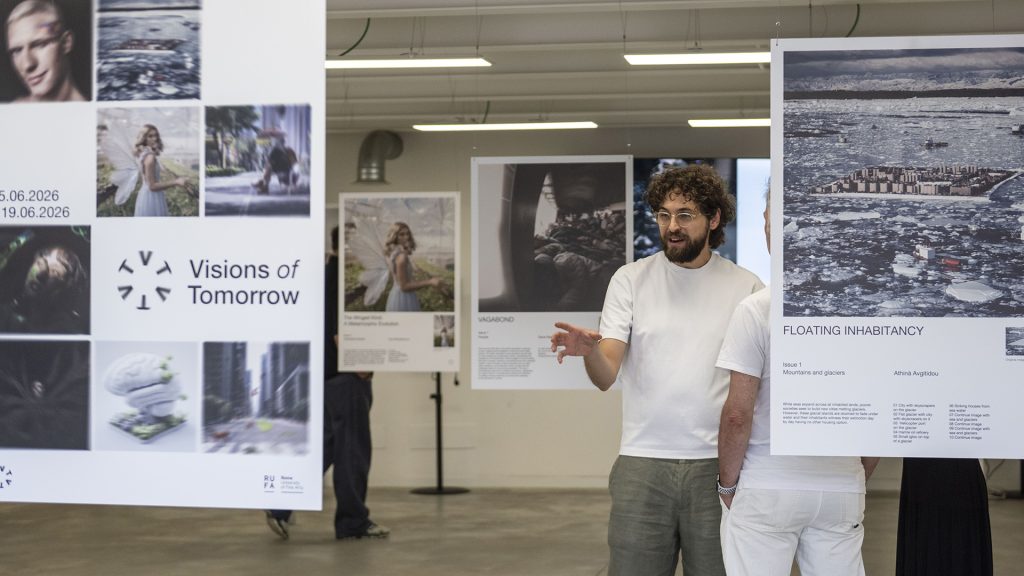
Illustrazione e fumetto: lo stile non è un filtro
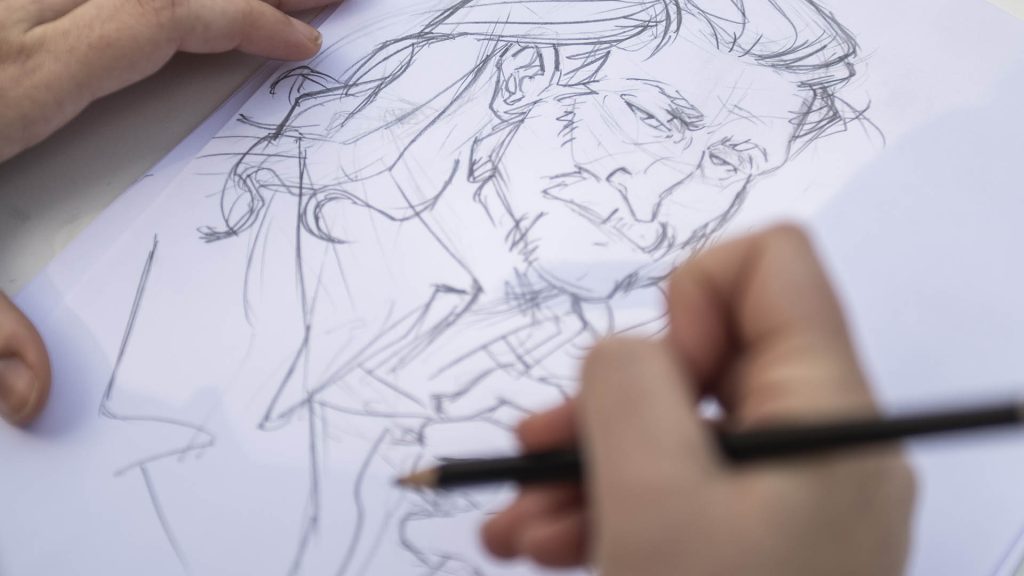
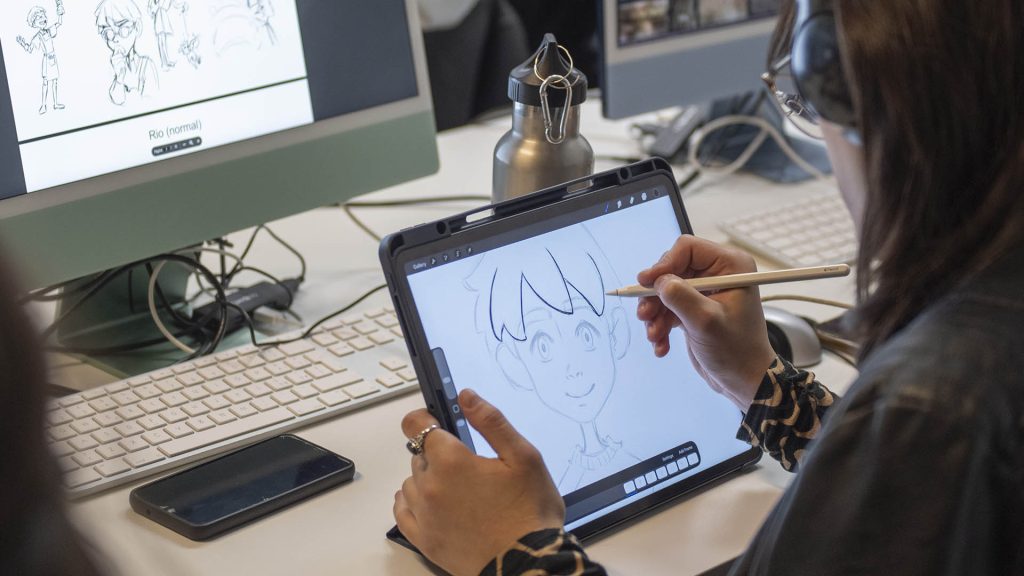
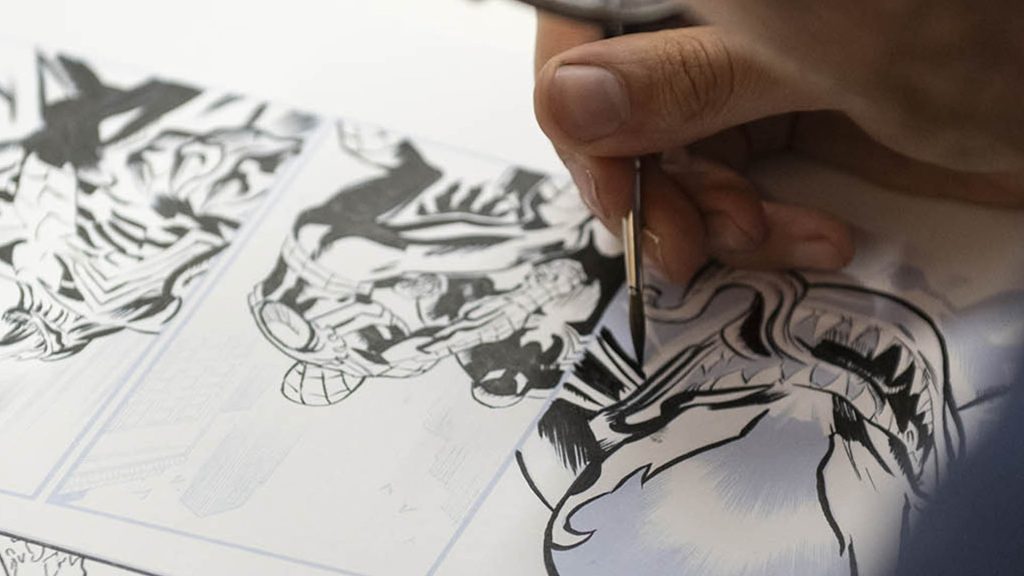
In comics and illustration, the arrival of AI raises another question: that of style and authorship.
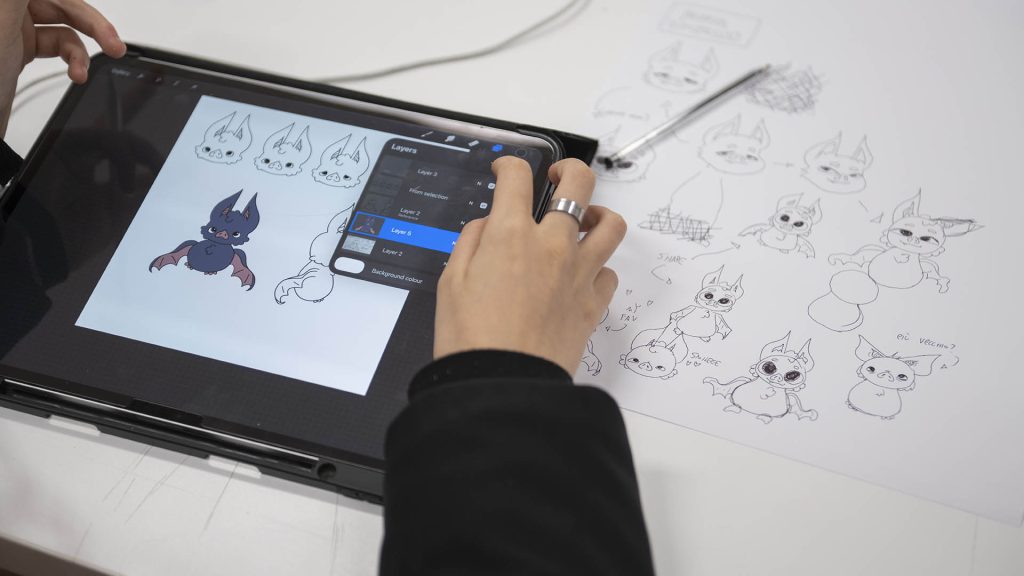
A visual surface can be imitated. A narrative, however, requires rhythm, page composition, character development, sequencing, intention, and point of view. These are skills that develop over time through drawing, cultural references, experimentation, and storytelling ability.
In the BA in Graphic Design – Comics and Illustration, coordinated by Claudio Spuri, graphic design interacts with the art of comics, illustration, editorial design, and creative writing. Spuri is an art director and graphic designer, as well as a Senior Professional Member of AIAP.
«Personal style is not a filter to apply. It is the way an author looks at the world and expresses themselves through their own visual language. It is built over years of marks, mistakes, and reading. AI can attempt to imitate a style, but it cannot have a unique and personal point of view.»
A contemporary education cannot ignore artificial intelligence. But neither should it turn AI into the centre of the entire learning journey.
Tools change rapidly. Method remains.
For this reason, a possible professional workflow begins with the brief and research, moves through the exploration of multiple solutions, and leads to selection, revision, and final evaluation.
AI can enter many of these stages: it can help explore, visualise, compare, and produce. The designer, however, remains responsible for the choices that transform those possibilities into a project. This is the difference between using a technology and having a direction.
This principle is also explored in Advertising exercises. For several years, Claudio Spuri has given students the option of using artificial intelligence tools to create visuals starting from the creative concept developed during the project.
Working groups are free to choose between AI and traditional techniques. When they use generative tools, however, prompt construction itself becomes part of the design process: formulating an effective request requires students to reflect on the words they use, the references they draw on, and the result they want to achieve, encouraging more careful research.
As Spuri observes, the quality of the tool does not automatically make the result better.
«Looking at the final student projects, I noticed that the quality of the images generated by AI reflected the quality of the student and their willingness to research and explore in greater depth. Like any tool, AI needs to be studied carefully and can produce different results depending on the designer using it.»
Artificial intelligence, moreover, cannot be left alone to manage the overall design process. A project evolves, encounters unexpected situations, requires interpretation, and demands decisions that cannot be reduced to the simple generation of an output. It is precisely in this ability to choose, correct, change direction, and give meaning to the result that the role of the designer continues to emerge.
Studying Graphic Design at RUFA
For those who want to turn an interest in images, communication, and new technologies into a comprehensive design education, RUFA offers a three-year BA in Graphic Design worth 180 CFA credits.
The programme is available in Italian in both Rome and Milan; an English-taught pathway is also available at the Rome campus. The course starts in October.
The programme combines visual communication, publishing, corporate identity, web design, packaging, copywriting, photography, motion graphics, and digital tools, with an approach based on learning by doing and engagement with real-world projects.
To explore the study plan, faculty, student projects, and entry requirements, you can find out more about the RUFA BA in Graphic Design.
You can also consult RUFA’s admission and enrolment procedures and speak with our advisors about the pathway best suited to your goals.
Domande frequenti
The impact of AI will not be the same across all activities. Some execution-based tasks can be automated or accelerated, while design skills, critical thinking, and technological expertise are becoming increasingly important. The Future of Jobs Report 2025 highlights both pressure on certain graphic design roles and growing demand for AI literacy, creative thinking, and analytical thinking. Education must therefore prepare students to design and direct new processes, rather than simply execute them.
Yes. Typography and composition make it possible to evaluate hierarchy, balance, rhythm, readability, and the relationship between elements. These skills are essential both for designing directly and for assessing outputs produced with generative tools. AI can propose numerous alternatives, but the designer must understand which solution best responds to the brief, the audience, and the context.
A comprehensive education should combine graphic design, typography, the history of visual communication, photography, publishing, web design, copywriting, packaging, motion design, and digital technologies. Today, these foundations are complemented by skills in the critical use of artificial intelligence and new generative tools. The goal is not to master a single platform, but to develop a method that can adapt as technology evolves.
Artificial intelligence can support research, brainstorming, references, moodboards, image generation, variations, editing, and output adaptation. However, these materials need to be integrated into a broader process: brief, research, concept development, selection, system design, evaluation, and production. The value therefore comes from the relationship between tool and method, not from automatic generation in isolation.
RUFA offers a three-year BA in Graphic Design worth 180 CFA credits, available in Italian at both the Rome and Milan campuses. The programme covers visual communication, graphic design, publishing, web design, photography, copywriting, packaging, motion design, and digital technologies. On the RUFA website, you can explore the Graphic Design programme and request a personalised guidance interview.