Advanced Artistic Drawing
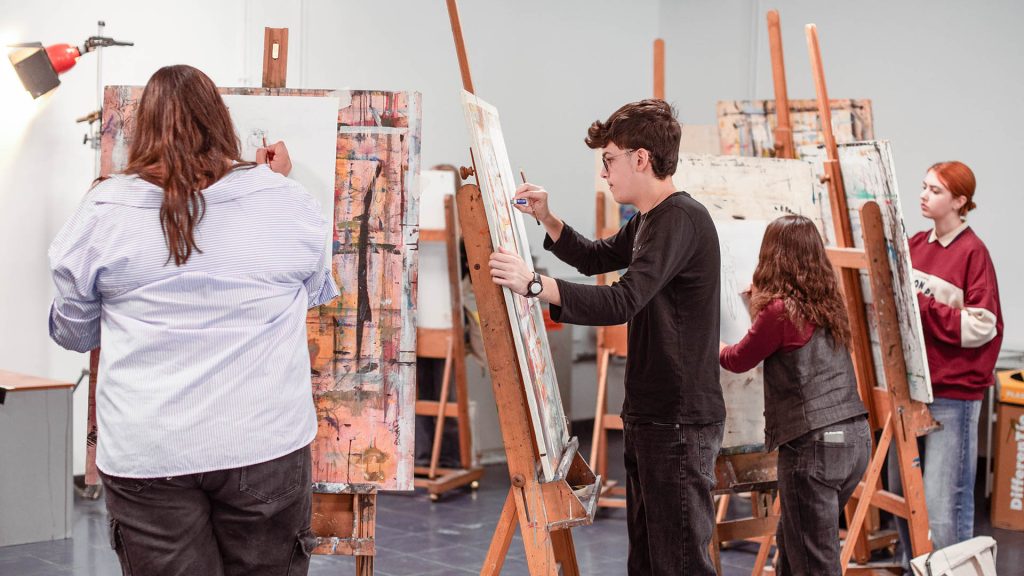
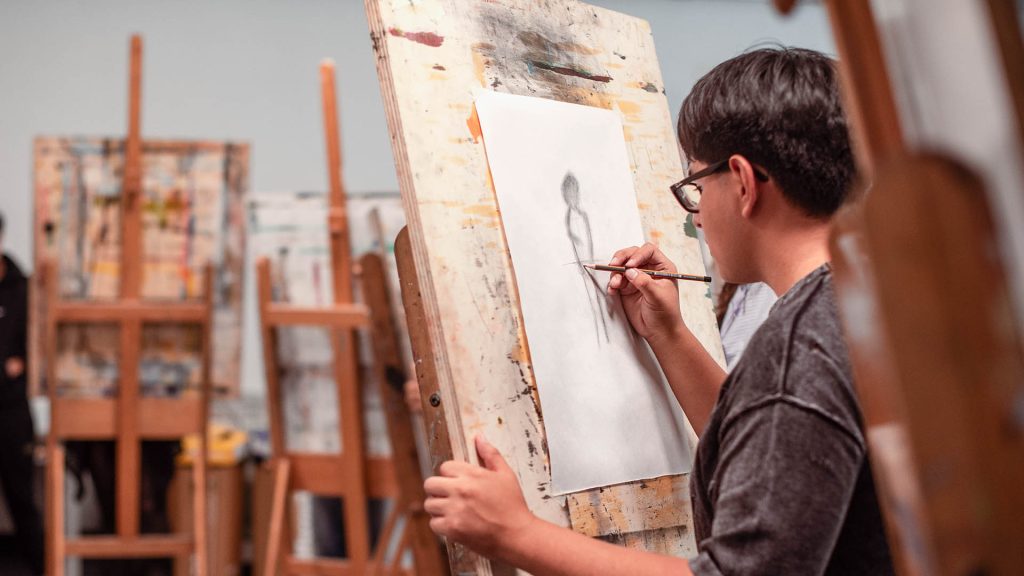
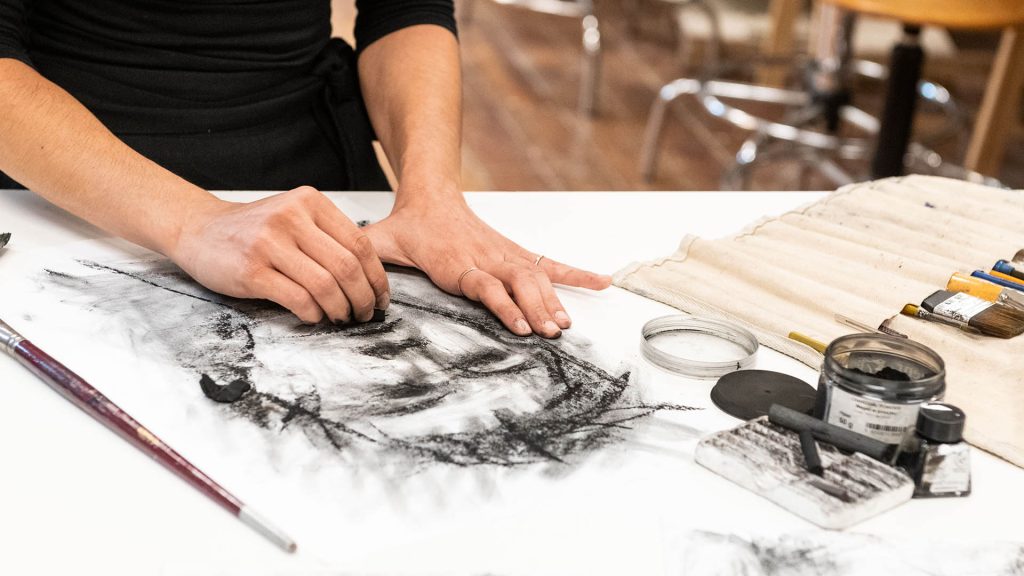
The Advanced Artistic Drawing short course aims to refine participants’ observation skills and artistic curiosity towards the world around them, helping them delve further into a variety of drawing techniques and materials with an increasingly experimental approach.
Drawing between gesture and observation
The course will guide participants through a variety of classical and gestural drawing exercises, with different focuses and particular attention to line, form, volume, light, shadow, movement, composition and interpretation, explored through the use of various materials and subjects, drawing from life, photographs or imagination.
At the end of the course, participants will receive a certificate of attendance, which may be used for the possible recognition of 1 CFA academic credit.
Refining Mark and Vision
Two life-drawing sessions with live models are planned, as well as one or more visits to museums or other places of interest in the city of Rome. These experiences will allow participants to engage directly with the representation of the human figure, exploring proportions, anatomy, posture and the dynamics of movement in greater depth.
External visits will also provide an opportunity to train the eye on architecture, urban spaces and works of art, encouraging greater compositional and interpretative awareness through direct observation.
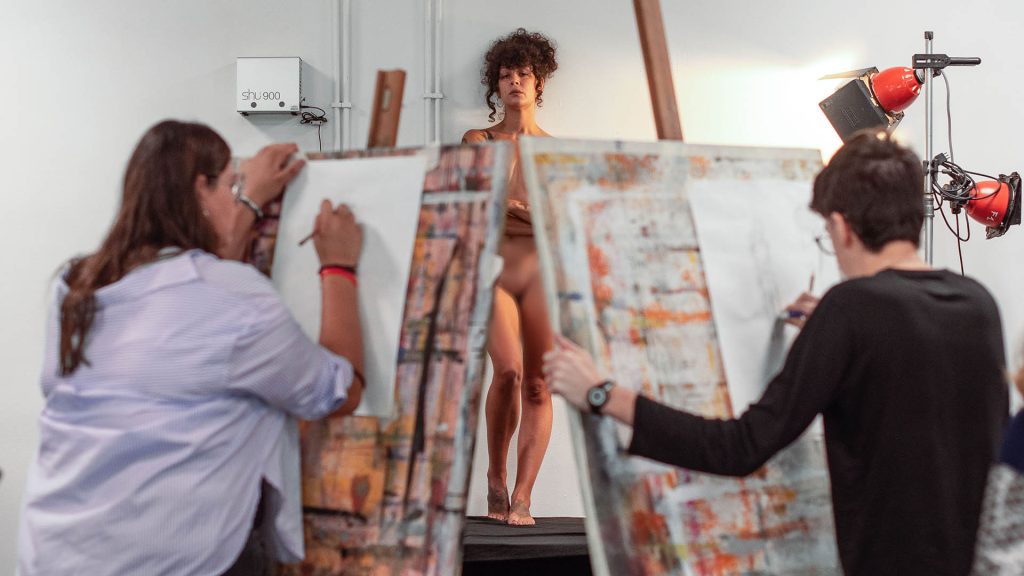
Course type: group – in person
Participants: Max. 15
Attendance: weekly, Saturdays from 9 am to 1 pm
Duration: 8 lessons – 32 hours total
Cost: €490.00 in a single payment or two instalments of €250.00 Requirements/materials: to be purchased by participants, see the Programme section
Language: Italian Lecturer: Ellen Wolf
Campus: RUFA – Via Benaco 2 Rome
Scheduled annual sessions: Autumn Session > 17 October – 5 December 2026, Winter Session > 9 January – 27 February 2027
In the Advanced Artistic Drawing II Course, participants will have the opportunity to improve their capacity for visual observation and consciously translate an impression into line, form, volume, light, shadow, movement, composition and interpretation through the use of various techniques, exercises and materials.
Topics and techniques covered during the course
– Basic concepts of perception theory applied to drawing;
– Light and shadow, shading techniques, greyscale: how to create volume;
– Line and negative space: contour, movement and expressiveness;
– Gestural drawing techniques: interpretation and representation;
– Life drawing (objects, live models, outings depending on participants’ interests);
– Grid drawing (attention to line and form);
– The human body (proportions, structure, foreshortening, movement);
– Portraiture (proportions, structure, portrait);
– Introduction to and experimentation with different materials (graphite, charcoal, chalk, ink, markers);
Materials
– A3 drawing pad with smooth or semi-rough white paper;
– 2 sheets of A3 black paper;
– Graphite or 2B, 4B, 6B, 8B pencils;
– Eraser and kneaded eraser;
– Pencil sharpener or craft knife;
– Ruler, minimum 40 cm;
– Charcoal (sticks and pencil);
– Blending stumps (small, medium, large);
– White chalk (stick and pencil);
– Charcoal/chalk fixative (or hairspray).
– Pen (Bic);
– Fineliners (0.1, 0.3, 0.5);
– Ink (black, 30 ml);
– Ink pen (or wooden stick);
– Round brushes (small-medium-large);
– Occasional photocopies upon request
AUTUMN SESSION
OCTOBER
17/10/2026
24/10/2026
31/10/2026
NOVEMBER
07/11/2026
14/11/2026
21/11/2026
28/11/2026
DECEMBER
05/12/2026
WINTER SESSION
JANUARY
09/01/27
16/01/27
23/01/27
30/01/27
FEBRUARY
06/02/27
13/02/27
20/02/27
27/02/27
Visual artist born in Denmark in 1993, based in Rome since 2014. She graduated in Painting in 2017 and Printmaking in 2020 from RUFA, winning several scholarships and completing an internship at the Pizzi Cannella Archive at Pastificio Cerere in San Lorenzo in 2017. From 2017 to 2022, she worked as a freelance archaeological illustrator for S.H. Andersen, Moesgaard Museum (DK). In 2022, together with artist Elisa Selli, she co-founded Lea APS (a non-profit cultural association for social promotion), an independent artist-run project space, and Artificio, an Art Lab for people with Down syndrome. Since 2021, she has taught Painting and Drawing; she is involved in tutoring students from secondary schools and art academies with Down syndrome; in 2023, she began working as a teaching assistant to artist and Prof. Andrea Aquilanti on the RUFA degree programme in Painting. She takes part in various group exhibitions, artist residencies and art competitions in Italy and abroad: most recently she was invited to a series of international group exhibitions at 8. Salon in Hamburg (DE), the Springtime Art-Camp Artist Residency organised by the Ministry of Culture of Azerbaijan in Baku (AZ), the Ladispolaneamente Artist Residency in Ladispoli (IT), and the 6th edition of the Seminaria Sogninterra Biennale of Environmental Art in Maranola (IT).
Website: Ellen Wolf
RUFA Students and Alumni: 50% discount
Former RUFA Short Courses and Summer Academy students: 10% discount
University students: 5% discount (upon presentation of a valid university student record)
Course packages/groups/families: contact corsibrevi@unirufa.it for tailored solutions and free guidance on the best combination of courses for each semester
Request information
Hai domande sul mondo RUFA? Siamo qui per orientArti!
Il nostro team orientamento è qui per te tutto l’anno, pronto a rispondere ad ogni tua domanda.