

A Journey Beyond the Horizon: A Conversation with Giada Franceschini
In a constantly evolving world of work, design management skills are increasingly intertwined with the challenges of technological innovation, sustainability and inclusive leadership. In this new format curated by Francesca Gollo, Coordinator of the RUFA Master in Design Management, we give space to the stories and experiences of professionals who are redefining the role of design in contemporary organisations.
A series of conversations created to inspire, connect and build a broader, more informed vision of creative management.
In this first interview, Francesca Gollo talks with Giada Franceschini, an expert in artificial intelligence applied to business design and founder of Parla AI and Boosha AI. An in-depth and visionary conversation about AI, spanning organisational models, sustainability and new social responsibilities.

Giada Franceschini
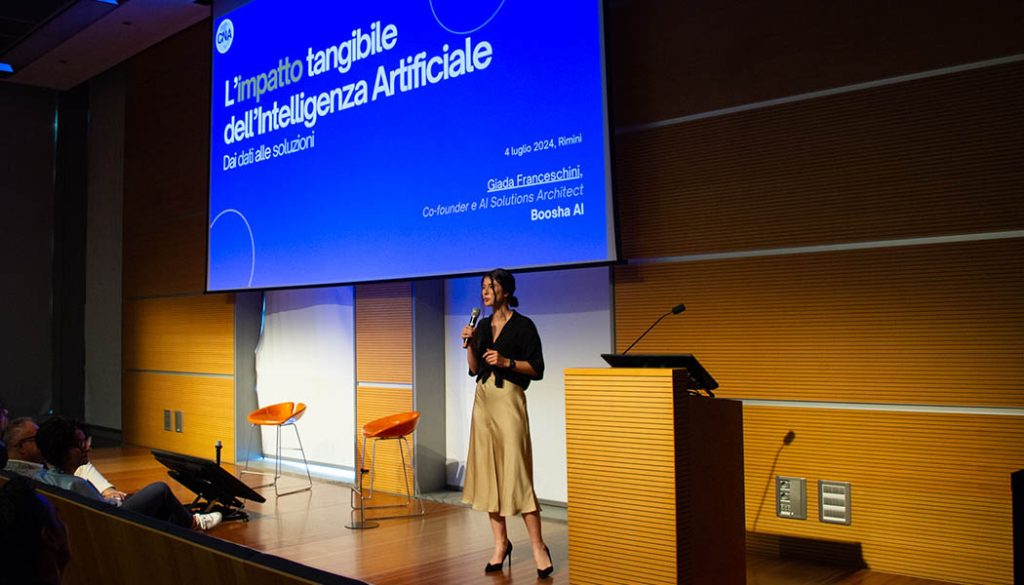
Giada Franceschini is CEO&co-founder of Parla AI and AI Solutions Architect&co-founder of Boosha AI. She currently leads AI implementation projects that combine technological innovation with a people-centred approach, enhancing human skills rather than replacing them.
She stands out for her ability to transform complex technological concepts into practical and accessible solutions, having delivered more than 200 training sessions on artificial intelligence in the last year alone.
A lecturer at IED, Uninettuno and Ninja Business School, she was recently invited to OpenAI’s DevDay in London and TED AI in San Francisco, confirming her role as a leading figure in the Italian AI landscape.
Her approach to technological innovation is deeply human-centric: every solution developed starts with understanding the people who will use it, their needs and the context in which they operate. Through Boosha AI and Parla AI, she is demonstrating that technological innovation can be both accessible and sustainable, representing a new model of leadership that combines technical excellence, entrepreneurial vision and social responsibility.
Francesca: Hi Giada, you’ve just returned from a 4-month trip around the world. Why did you make this choice and what did it leave you with?
Giada: I have always believed that experiences shape the way we think more than any book or course. This journey began with a simple question: how can I broaden my perspective? I visited incredible places, from Rio de Janeiro to Ushuaia and Sydney, from French Polynesia to South Africa.
The real challenge was maintaining my professional activity while travelling across different continents. I was living in two parallel dimensions: my everyday working microcosm and the vastness of the cultures I was encountering.
What I bring home with me is the awareness that the truly important things in life are human and relational. Seeing such different cultures while finding elements that unite us all gave me a new perspective on my work. Technological innovation only makes sense if it improves human connection, not if it replaces it.
Francesca. Can you tell us about your profession?
Giada: I work with artificial intelligence using a very practical approach. I come from a hybrid background: I studied Computer Science for Management at the University of Bologna, but then followed an unconventional path, moving from marketing and growth hacking to implementing AI solutions for companies.
My “strength” has always been seeing AI not as an end in itself, but as a means of solving concrete problems. During my previous professional experiences, I used machine learning algorithms to optimise marketing campaigns without anyone asking me to – simply because it was the most efficient way to achieve results.
In 2024 I decided to focus entirely on artificial intelligence because I saw a huge gap between the potential of these technologies and their actual implementation in Italian companies. My mission is to make AI accessible, understandable and useful even for people without a technical background.
F. Over the years, then, you must have supported many companies through this new transition. Today, artificial intelligence is increasingly transforming the way organisations operate and are structured. In your opinion, what is the current role of AI in the design of organisational models and management processes?
G.: What I am observing in the field is a fundamental shift: from optimising individual processes to completely rethinking organisational structures.
AI is no longer just a tactical tool, but a strategic element that influences organisational design. The most forward-thinking companies are using it not only to automate processes but also to create new working models that amplify human capabilities.
One interesting aspect is how AI is flattening traditional hierarchies. Cross-functional teams, supported by artificial intelligence tools, are becoming more autonomous and able to make decisions based on concrete data, without always having to move back up the chain of command.
The real revolution, however, is in decision-making: AI provides insights that previously required days of analysis, allowing managers to focus on strategic decisions rather than data processing. This is transforming the role of management from controller to enabler, from supervisor to mentor.
F. Can you give us some concrete examples of how AI is being used to support organisational design or the strategic management of companies?
G. I recently supported an Italian manufacturing company that implemented an AI system for supply chain management. The most surprising result was not the 27% reduction in operating costs, but the way this completely transformed roles within the organisation.
Managers who previously spent 60% of their time analysing reports and managing emergencies now devote more than 70% to strategic planning and innovation. Middle management has evolved from controller to facilitator, while operational teams have gained greater decision-making autonomy thanks to predictive dashboards.
Another example comes from a company in the fashion sector that implemented an AI system for trend analysis and collection planning. This led to a complete restructuring of the creative process: designers no longer work in isolation before submitting their ideas to marketing, but collaborate in real time with market data, creating a much more fluid and integrated process.
In both cases, AI did not replace people, but profoundly changed the way they work together, creating more horizontal and collaborative structures.
F. Among the most critical voices on AI, many highlight its environmental impact, including that of maintaining servers.
G. It is an absolutely valid criticism that deserves attention. Training a large language model can consume an amount of energy equivalent to that used by five cars over their entire life cycle. We cannot ignore this aspect.
The good news is that we are seeing significant progress in the energy efficiency of AI models. New architectures require less computing power to achieve better results than their predecessors. In addition, many tech companies are investing in renewable energy to power their data centres.
What I find particularly interesting is the emergence of an approach I call “sustainable AI”, where efficiency is not only a technical issue but also an ethical one. It means choosing the appropriate AI model for each specific task instead of always using the most powerful one available.
In the future, I hope to see more and more data centres using natural cooling and solar energy, demonstrating that innovation and sustainability can go hand in hand. I believe this is the direction we need to take: responsible innovation that considers environmental impact as a crucial factor in technological decision-making.
F. Looking to the future, what strategies should companies adopt to integrate AI into organisational design processes effectively and sustainably?”
G. Companies that want to integrate AI effectively into their organisational design processes should follow a “marathon runner” rather than a “sprinter” approach.
As in preparing for a marathon, you do not tackle all 42 km at once. You proceed one kilometre at a time, constantly measuring results and adjusting your course. During my two marathons in 2018 and 2019, when I reached the 30th km exhausted, I would tell myself: “Only 10 left, how many times have you already run 10 km?” This approach to breaking down complex problems is also fundamental when implementing AI.
Specifically, I recommend these strategies:
1 – Start with a clear vision but implement incrementally: Define where you want to go, but proceed through measurable stages, with specific objectives for each phase.
2 – Adopt a human-centric approach: AI must enhance human capabilities, not replace them. The focus must be on the value people can add once they are freed from repetitive tasks.
3 – Invest in continuous training: Making teams aware of how these technologies work is fundamental for their effective and responsible use.
4 – Create safe spaces for experimentation: Allow teams to test and make mistakes with AI in controlled environments before implementing it on a large scale.
5 – Measure what really matters: Not only operational efficiency, but also the impact on employee satisfaction, innovation and company culture.
F. What are the main ethical, organisational and cultural challenges that managers and designers will have to face when using artificial intelligence to innovate the structure and identity of companies?
G. The most significant ethical challenge I see emerging concerns the alignment of values and transparency. AI models inevitably reflect the values of those who designed and trained them. When an organisation implements these systems, it is implicitly adopting those values as well.
From an organisational perspective, the main challenge is avoiding both excessive optimism and total rejection. I have met managers who thought AI would magically solve all their problems, and others who saw it as a threat to be avoided. The reality lies somewhere in between: it is a powerful tool that requires a clear strategy and deep understanding.
From a cultural perspective, I see two interconnected challenges. The first is technological “impostor syndrome” – people who feel inadequate when faced with these new technologies. I experienced it personally at university, watching colleagues solve in minutes problems that took me days. The second is resistance to change, often disguised as concerns about security or reliability.
In all my teaching, I always emphasise that the goal is not to change anyone’s mind, but to provide tools for informed assessment and to develop critical thinking. It does not matter whether you are in favour of or against AI; what matters is that your position is based on genuine understanding rather than fear or hype.
My approach to marathon running taught me to see obstacles as opportunities. The same applies to AI: the ethical challenges it presents are actually opportunities to define who we want to be as organisations and as a society.