Digital Illustration
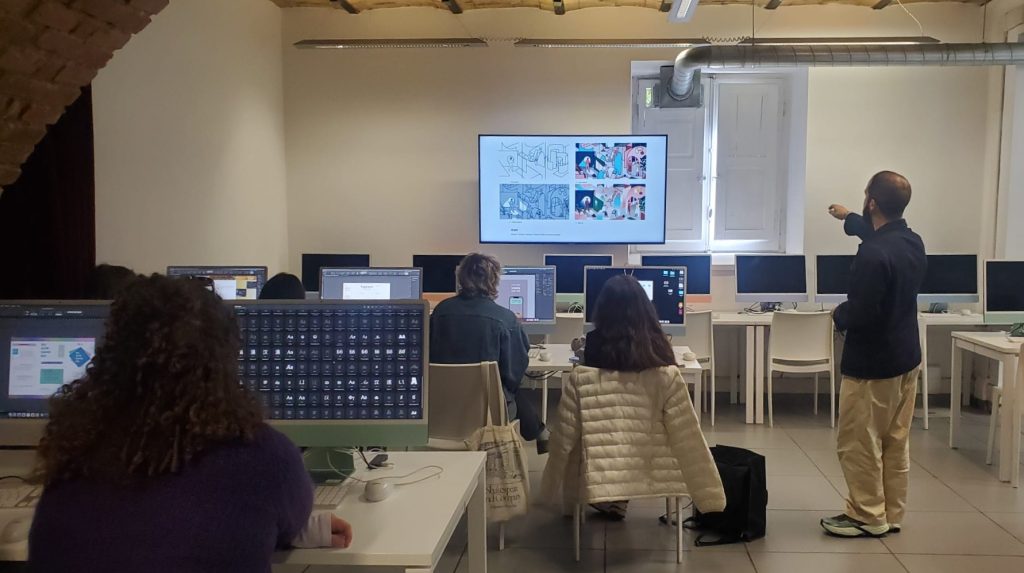
Transform texts, briefs and intuitions into images that tell a story. The course guides you through contemporary editorial illustration, from visual research to the development of a personal, effective and recognisable style.
Illustrating means interpreting
The Digital Illustration short course guides you through the design of images for publishing and contemporary communication. You will learn how to read a text, interpret a brief and translate concepts, atmospheres and messages into an original visual narrative.
Through the analysis of editorial projects, practical exercises and group discussions, you will explore every stage of the creative process: from source research to concept development, from preliminary studies to composition, through to the creation of the final image.
Developing a personal illustration style
Drawing on the lecturer’s professional experience, you will become familiar with the methods, dynamics and tools involved in the work of an illustrator. You will develop the ability to create clear and expressive images that respond to a client’s needs without sacrificing your own identity. The course will help you strengthen your critical eye, experiment with visual solutions and define a personal and recognisable language. By the end of the course, you will have acquired a design method that can be applied to editorial commissions and further educational experiences.
Participants who do not have basic skills in the Adobe suite are advised to first attend the modular Visual Design Lab.
Course type: group – in person
Participants: Max. 10
Attendance: weekly, Saturdays from 9 am to 1 pm
Duration: 10 lessons – 40 hours total
Cost: €690.00 in a single payment or two instalments of €350.00
Materials: to be purchased by the student
Requirements/materials: graphics tablet strongly recommended
Language: Italian
Lecturer:Andrea Mongia
Campus: RUFA – Via Benaco 2, Rome
Lesson 1 – Introduction to editorial illustration: contemporary visual languages, historical overview and visual research through the analysis of illustrators.
Lesson 2 – From text to image: analysing the brief, identifying key concepts and translating them into visual form through design exercises.
Lesson 3 – Narrative illustration: constructing a scene that develops a story over time (before/during/after). First brief assigned.
Lesson 4 – Narrative development: exploration of sketches, composition and visual direction of the project.
Lesson 5 – Final narrative illustration: definition of style, colour and final image.
Lesson 6 – Conceptual illustration: transforming an idea into an image through metaphor, symbol and synthesis. Second brief assigned.
Lesson 7 – Concept development: visual research, sketches and colour tests to define different solutions.
Lesson 8 – Final conceptual illustration: refinement of the final image and consistency of the visual language.
Lesson 9 – Concept from keywords: development of an illustration without text, starting from a general concept. Third brief assigned and sketches developed.
Lesson 10 – Finalisation: review, refinement and presentation of the final project.
MARCH
13/03/2027
20/03/2027
APRIL
03/04/2027
10/04/2027
17/04/2027
24/04/2027
MAY
08/05/2027
15/05/2027
22/05/2027
29/05/2027
Andrea Mongia is an Italian illustrator based in Rome. His practice focuses on contemporary editorial illustration, creating images that explore the relationship between image, memory and atmosphere. He collaborates with international magazines, cultural institutions and brands, creating illustrations for magazines, campaigns and editorial projects. His clients include Airbnb, Arper, Assicurazioni Generali, Barilla, British Airways, Domus, Forbes, IKEA, La Repubblica, Loro Piana, Louis Vuitton, Luxottica, Monocle, Mr Porter, Slowear, The Boston Globe, The Economist, The Guardian, The New York Times, The New Yorker, The Wall Street Journal, as well as institutions such as the Consulate General of Italy in New York, the French Ministry of the Interior and the Italian Cultural Institute in Dakar. In 2019, he was included in the Forbes 30 Under 30 Europe – Art & Culture list, which recognises some of Europe’s most influential creatives. His work has also received numerous international awards, including the Gold Medal from the Society of Illustrators of New York (2022), the Award of Excellence from Communication Arts (2023) and Merit Winner recognition from 3×3 Magazine (2023), and has been selected several times for American Illustration (AI-AP). He also taught at RUFA – Rome University of Fine Arts, Milan campus (2024–2025), where he taught Artistic Anatomy on the Bachelor’s Degree Programme in Graphic Design – Comics and Illustration.
Studenti e Alumni RUFA: agevolazione del 50%
Ex studenti Corsi Brevi e Summer Academy RUFA: agevolazione del 10%
Studenti universitari: agevolazione del 5% (previa esibizione del libretto universitario)
Pacchetto corsi/gruppi/famiglia: contatta corsibrevi@unirufa.it per soluzioni personalizzate e un orientamento gratuito sulla combinazione di corsi per semestre
Request information
Hai domande sul mondo RUFA? Siamo qui per orientArti!
Il nostro team orientamento è qui per te tutto l’anno, pronto a rispondere ad ogni tua domanda.