

ELIA CANEVASCINI’S JOURNEY WITH LÄÄNE/VOSTOK
From RUFA to the Locarno Film Festival
Born in Locarno, trained in Rome and brought to Estonia through an Erasmus experience, Elia Canevascini’s journey gave rise to Lääne/Vostok, the documentary by the young RUFA graduate selected for the 79th Locarno Film Festival in the Pardi di Domani – National Competition section.
Some films begin with a clearly defined idea, while others take shape gradually, through encounters, journeys and places that eventually become an integral part of the story they seek to tell. This is the case with Lääne/Vostok, Elia Canevascini’s experimental documentary, which grew out of a study-abroad experience and developed over more than a year before reaching the Locarno Film Festival.
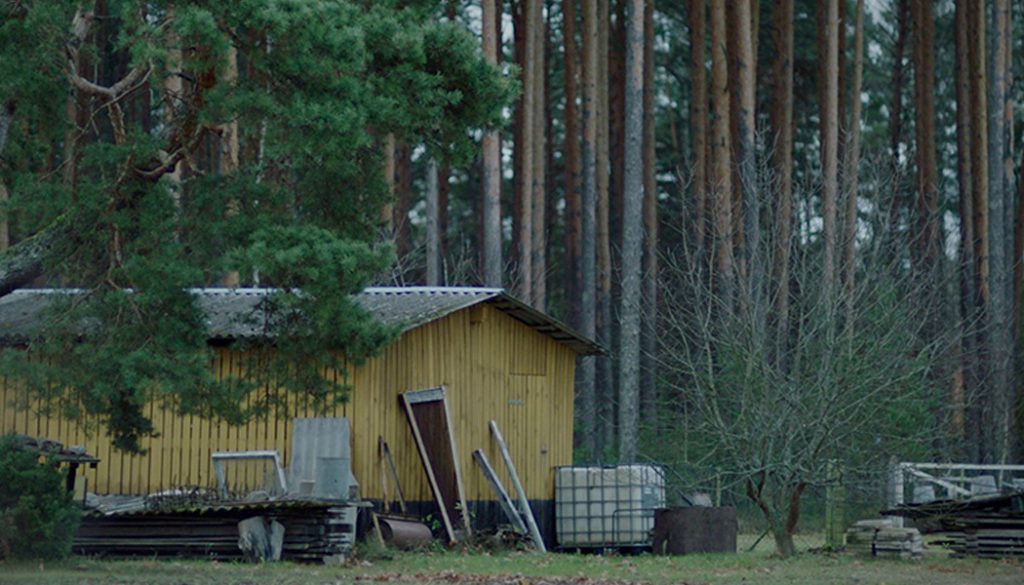
Born in Locarno in 1998 and trained in filmmaking in Rome at RUFA – Rome University of Fine Arts, Canevascini took part in the Erasmus programme in 2024, spending a semester at Tallinn University in Estonia. It was there that the idea for the project began to take shape: to tell the story of the border between Estonia and Russia, a territory that has taken on particular significance in light of renewed geopolitical tensions in the Baltic region following the outbreak of the war in Ukraine.
The theme of borders, however, is not entirely unfamiliar to the filmmaker’s personal story. Having grown up between Switzerland and Italy, Canevascini has always experienced that geographical dimension as part of his everyday life. His time in Estonia therefore gave him the opportunity to engage with a profoundly different kind of border: not simply a geographical line, but a space shaped by history, national identities and contemporary political tensions.
“I was born and raised close to a border that is, fortunately, peaceful, so I think it is natural for me to be drawn to realities that are similar to my own, yet at the same time very different, such as the border between Estonia and Russia.”
During his semester at Tallinn University, the idea began to develop into a fully-fledged film project. Canevascini assembled a crew locally and, in November 2024, spent a week travelling along the border between Estonia and Russia with his collaborators, gathering hours of footage.
The work continued over the following months: the filming was followed by the selection of material, the development of the audio track and the various stages of post-production. For the audio production, the actors recorded in Estonia while Canevascini supervised the work remotely from Switzerland.
What had begun as an idea developed during a period of study abroad gradually became an increasingly structured project, eventually becoming Canevascini’s graduation thesis.
Throughout this process, his education at RUFA became closely intertwined with his international experience. It was through RUFA’s Erasmus programme that the filmmaker had the opportunity to spend a semester in Estonia, while discussions with his lecturers supported the project’s development. Christian Angeli, documentary filmmaking lecturer and Canevascini’s thesis supervisor, played a particularly important role, providing guidance both during the initial development of the idea and throughout post-production.
“Studying at RUFA first of all gave me the opportunity to take part in the Erasmus programme in Estonia and the time I needed to develop the documentary. During my academic studies, I also had the chance to meet Professor Angeli, who proved to be an invaluable source of support throughout the project’s creative process.”
When a Thesis Continues Beyond Graduation
The project did not come to an end with the completion of Canevascini’s academic journey. He graduated from RUFA in July 2025, but continued working on Lääne/Vostok, refining the sound design, colour correction and end-credit graphics. The final version of the documentary was completed in early 2026.
This marked a significant transition: a project born within the Academy began to take on a life beyond it, while still retaining strong roots in the educational path from which it emerged. Among the skills Canevascini considers most valuable from his time at RUFA is the ability to coordinate the different members of a film crew throughout the entire production process.
Arriving at Locarno
On 12 February 2026, Lääne/Vostok was submitted to the Locarno Film Festival. In mid-June, confirmation arrived that the film had been selected for the Pardi di Domani – National Competition section, later officially announced with the publication of the programme for the Festival’s 79th edition.
For a project that began as a graduation thesis, the selection marked a transition into an entirely different dimension: the film moved beyond the academic environment and met the audience of an international film festival.
The relationship with the audience is one of the aspects Canevascini considers most important about the Locarno experience. As he explains, “a film does not truly exist unless it is shown”, and engaging with viewers outside the academic environment is a fundamental part of a film’s journey.
“What I will remember most from the Locarno experience is the great satisfaction of seeing the amazement on my collaborators’ faces at what we had achieved together. I am proud to have worked with this crew, without whom I would not have been able to make the documentary.”
What’s next?
Taking part in Locarno is not necessarily an endpoint, but rather one stage in a journey that, for Canevascini, is still only beginning.
“My career in the film industry is still in its early stages, and I hope to find the right opportunity for me soon. In the meantime, I continue to follow the philosophy of adapting to the flow of events.”
From experimental documentary to the writing of a new fiction short film, his stated goal is to continue building a career in cinema, drawing on the experience gained through education, international opportunities and his first encounters with the festival circuit.
The story of Lääne/Vostok is therefore one of a journey that begins in a university classroom and gradually moves beyond it: an Erasmus experience that becomes research, research that becomes a film, a thesis that continues to evolve after graduation and, finally, a first major opportunity to meet an international audience.